 Every spring on the south polar ice cap of Mars brings violent eruptions of carbon dioxide gas carrying dark sand and dust high aloft.
The seasonal frosting and defrosting of ice results in the appearance of a number of features, such dark dune spots with spider-like rilles or channels below the ice, where spider-like radial channels are carved between the ground and ice, giving it an appearance of spider webs, then, pressure accumulating in their interior ejects gas and dark basaltic sand or mud, which is deposited on the ice surface and thus, forming dark dune spots. This process is rapid, observed happening in the space of a few days, weeks or months.
The geological features called dark dune spots and spiders were separately discovered on images acquired by the MOC camera on board the Mars Global Surveyor during 1998-1999. At first it was generally thought they were unrelated features because of their appearance. The first "Jet" or "Geyser" models start to be proposed and refined from 2000 onwards. The name 'spiders' was coined by Malin Space Science Systems personnel, the developers of the camera. The unusual shape and appearance of these 'spider webs' and spots caused a lot of speculation about their origin. The first years' surveillance showed that during the following Martian years, 70% of the spots appear at the exact same place, and a preliminary statistical study indicated that dark dune spots and spiders are related phenomena as functions of the cycle of CO2 ice condensation and sublimation. Thermal imaging during 2006 revealed that the temperature of these structures are as cold as the ice that covers the area. Soon after their first detection, they were discovered to be negative topographical features: radial troughs or channels of what today are thought to be geyser-like vent systems.
The geysers' two most prominent features (dark dune spots and spider channels) appear at the beginning of the Martian spring on dune fields covered with carbon dioxide (CO2 or 'dry ice'), mainly at the ridges and slopes of the dunes; by the beginning of winter, they disappear. Dark spots' shape is generally round, on the slopes it is usually elongated, sometimes with streams (water?) that accumulate in pools at the bottom of the dunes. Dark dune spots are typically 15 to 46 meters wide and spaced several hundred feet apart. Spider features form a round lobed structure reminiscent of a spider web radiating outward in lobes from a central point. Its radial patterns represent shallow channels or ducts in the ice formed by the flow of the sublimation gas toward the vents. The entire spider channel network is typically 160–300 m across.
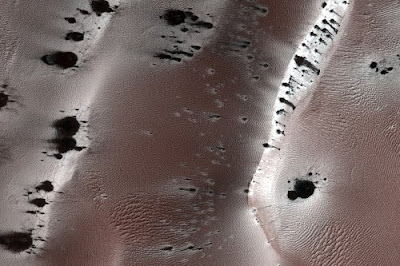 Dark dune spots, high resolution color image
by the HiRISE camera (Credit: NASA)Time-lapsed imagery performed by NASA confirms the apparent ejection of dark material following the radial growth of spider channels in the ice. Small dark spots generally indicate the position of spider features not yet visible; it also shows that spots expand significantly, including dark fans emanating from some of the spots, which increase in prominence and develop clear directionality indicative of wind action.
A number of geophysical models have been investigated to explain the various colors and shapes' development of these geysers on the southern polar ice cap of Mars.
Some teams propose dry venting of carbon dioxide gas and sand, occurring between the ice and the underlying bedrock. It is known that a CO2 ice slab is virtually transparent to solar radiation where 72% of solar energy incident at 60 degrees off vertical will reach the bottom of a 1 m thick layer. In addition, the ice thickness is measured in several target areas, and it was discovered that the greatest thickness of the CO2 frost layer in the geysers' area is about 0.76–0.78 m, supporting the geophysical model of dry venting powered by sunlight. As the southern spring CO2 ice receives enough Sun energy, it starts sublimation of the CO2 ice from the bottom. This vapor accumulates under the slab rapidly increasing pressure and erupting. High-pressure gas flows through at speeds of 161 km/h or more; under the slab, the gas erodes ground as it rushes toward the vents, snatching up loose particles of sand and carving the spidery network of grooves. The dark material falls back to the surface and may be taken up slope by wind, creating dark wind streak patterns on the ice cap.
Another model explores the possibility of active water-driven erosive structures, where soil and water derived from the shallow sub-surface layer is expelled up by CO2 gas through fissures eroding joints to create spider-like radiating tributaries capped with mud-like material and/or ice. Data obtained by the Mars Express satellite in 2004, confirmed that the southern polar cap has an average of 3 kilometres thick slab of CO2 ice with varying contents of frozen water, depending on its latitude: the bright polar cap itself, is a mixture of 85% CO2 ice and 15% water ice. The second part comprises steep slopes known as 'scarps', made almost entirely of water ice, that fall away from the polar cap to the surrounding plains. This transition area between the scarps and the permafrost is the 'cryptic region', where clusters of geysers are located.
A team of Hungarian scientists propose that the dark dune spots and channels may be colonies of photosynthetic Martian microorganisms, which over-winter beneath the ice cap, and as the sunlight returns to the pole during early spring, light penetrates the ice, the microorganisms photosynthesise and heat their immediate surroundings. A pocket of liquid water, which would normally evaporate instantly in the thin Martian atmosphere, is trapped around them by the overlying ice. Since their discovery, fiction writer Arthur C. Clarke promoted these formations as deserving of study from an astrobiological perspective.
A multinational European team suggests that if liquid water is present in the spiders' channels during their annual defrost cycle, the structures might provide a niche where certain microscopic life forms could have retreated and adapted while sheltered from UV solar radiation. A British team also considers the possibility that organic matter, microbes, or even simple plants might co-exist with these inorganic formations, especially if the mechanism includes liquid water and a geothermal energy source.
Further reading:
Geology of MarsNASA Findings Suggest Jets Bursting From Martian Ice CapMars' South Pole Ice Deep and WideWater at Martian south poleMartian spots warrant a close lookDark Dune Spots: Possible Biomarkers on Mars?


